
STARTUP
Microsoft To Pour A$25 Billion Into Australian AI Infrastructure, Cyber Defence, And Skills By 2029

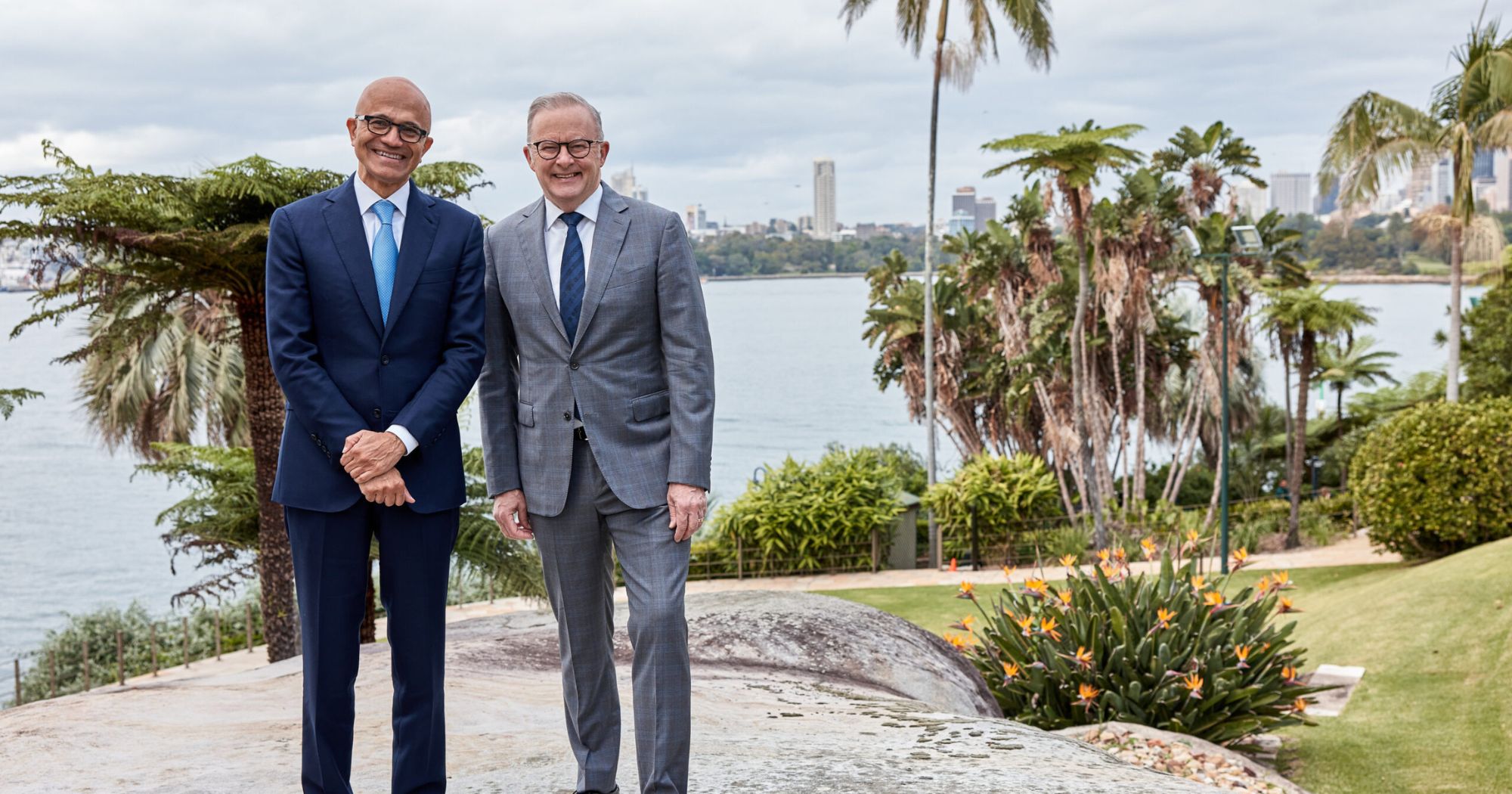
Microsoft has announced its largest-ever investment in Australia, committing A$25 billion by the end of 2029 to expand Azure AI infrastructure, extend its national cyber defence partnership with the federal government, and train three million Australians in workforce-ready AI skills.
The commitment was announced last Thursday in Sydney by Microsoft CEO Satya Nadella alongside Prime Minister Anthony Albanese, coinciding with the Sydney stop of Microsoft’s global AI Tour. It builds on a $ 5 billion investment the company made in October 2023, which expanded its Australian data centre footprint to 29 sites across three Azure regions.
Microsoft plans to expand that existing footprint by more than 140% by the end of 2029, deploying advanced AI processors and adding local supercomputing capacity. The investment is underpinned by a Memorandum of Understanding with the federal government that aligns Microsoft with the recently released Expectations for Data Centres and AI Infrastructure Developers — a framework covering national interest, clean energy, water sustainability, local skills and jobs, and research capability.
“Australia has an enormous opportunity to translate AI into real economic growth and societal benefit,” Nadella said. “That is why we are making our largest investment in Australia to date, committing A$25 billion to expand AI and cloud capacity, strengthen cybersecurity, and expand access to digital skills across the country.”
Albanese framed the announcement as a key plank of the government’s National AI Plan. “We want to make sure all Australians benefit from AI,” he said. “Microsoft’s long-term investment in our national capability will help deliver on that plan — strengthening our cyber defences and creating opportunity for Australian workers and businesses.”
New analysis from EY-Parthenon, released to coincide with the announcement, estimates Microsoft was responsible for $36 billion in local economic contribution in the 2025 financial year and sustained the equivalent of more than 186,000 full-time jobs.
What the infrastructure spend actually covers
The A$25 billion figure combines capital and operational expenditure through to the end of 2029, and is targeted at Azure AI supercomputing capacity, cloud infrastructure, and the GPU-backed compute that Australian enterprises, government agencies, and startups increasingly need to run and scale AI workloads in-country.
Sovereign AI capacity has become a pressure point for Australian founders building on international hyperscalers, particularly those working with regulated data or pitching to government, defence, and financial services buyers. A 140% expansion of local Azure capacity materially changes what can be built and hosted domestically.
Microsoft will also collaborate with the newly established Australian AI Safety Institute, supporting its mandate to monitor, test, and evaluate advanced AI systems. The collaboration will include work on human-AI interaction risks in companion chatbots and conversational AI — a pointed inclusion given the regulatory scrutiny those categories have attracted globally.
Expanding the ASD Cyber-Shield
Microsoft is extending its Microsoft-Australian Signals Directorate Cyber-Shield (MACS) partnership, first established in 2023, to cover additional federal agencies. Since launch, MACS has secured more than 38,000 government accounts, identified 35 previously unknown vulnerabilities, and delivered a bespoke engineering solution integrating Microsoft Sentinel with the government’s Cyber Threat Intelligence Sharing program.
The expansion will deepen Microsoft’s work with the ASD, the Department of Home Affairs, and the Digital Transformation Agency. A new collaboration with Home Affairs will focus on connectivity, data centre resilience, and hyperscale cloud infrastructure resilience under a shared public-private framework for national and economic resilience.
Three million Australians to be trained by 2028
The skilling commitment is the largest of its kind ever made in Australia. It follows Microsoft’s earlier goal of skilling one million people across Australia and New Zealand by the end of 2025, which was hit ahead of schedule.
Two programs launched alongside the announcement:
Microsoft Elevate for Educators, a free program that helps teachers and school leaders build confidence in using AI responsibly, is now available in Australia. A new partnership with youth platform Anyway (formerly Year13, which acquired Student Edge last year) will bring a free AI-powered Career Coach to up to 1,000 Australian schools.
Microsoft Elevate for Changemakers, also launching alongside the announcement, targets nonprofit and social impact leaders with free AI-readiness credentials and hands-on capability-building.
For the local startup ecosystem, the expansion of in-country AI compute, the continued access programs for Australian startups referenced in Microsoft’s commitments, and a materially larger pool of AI-skilled workers are the most tangible flow-on effects. Whether Australia can convert infrastructure scale into homegrown AI companies of consequence remains the open question.